

I was asked by my manager to help prepare for a series of user interviews with 10 participants from our platform. At first glance, it sounded straightforward. But something felt… missing. We knew who we were talking to but not really why we were talking to them. So before jumping into logistics, I pushed for clarity.

Clarifying the Goal I replied with a simple email:
To help properly prepare, could you clarify what we’re aiming to uncover with these interviews? Happy to assist with: scheduling, structuring questions, translations, and synthesizing feedback.
The response came back that I must focus on structuring the interviews. That helped narrow things down, but I still needed context. After a few more conversations, a clearer picture emerged: Interviews would last ~1 hour Participants were already motivated to share (no incentives needed, always a win). The candidates themselves had a lot of questions, especially around monetization and future features they wanted to see on the website. So this wasn’t just research from our side, just for the sake of it. It was a two-way exchange. Our key users wanted to be heard, and we needed direction.
Choosing the Right Interview Approach Before writing a single question, I explored how we should structure the interviews. There are generally three approaches:
Strict Script (Structured) Great for consistency and comparison, but can feel robotic and limit depth.
Topic-Based (Semi-Structured) A balance between structure and flexibility. Allows for natural conversation and deeper insights.
Task-Based (Flow-Oriented) Ideal for observing real behavior (e.g., uploading a video), but less focused on motivations.
Given our goals, the choice was clear:
Semi-structured interviews, with a touch of task-based exploration. We wanted consistency and real conversations, not a questionnaire session.
Designing the Interview with a 1-hour timebox, I aimed for 8 core questions. Not 20. Not a long checklist. Just enough to go deep without rushing (and yes, to leave room to breathe).
The structure:
4 discovery questions → context, motivation, history
2 usability questions → workflows, friction
2 strategic questions → competition, improvements
This gave us a clean, focused framework.

First Draft (Expanding the Question Pool) Instead of locking questions too early, I created a pool of possibilities under each category.
Discovery (Context + Motivation)
How do you currently use the platform?
What has kept you using it over time?
What would make you stop?
Why did you choose us over others?
How has your usage evolved?
What improvements have you noticed recently?
How often do you use it, and for what purpose?
How useful are the statistics for you?
Usability (Task + Friction) Walk me through how you upload or stream content.
How does the streaming experience feel?
How is the upload process across formats (videos, galleries, stories)?
Where do you hesitate?
What feels easy vs frustrating?
What almost stopped you from signing up with us?
Does your content meet user expectations?
How do you attract users to your content?
I also layered in pricing-related usability, since monetization was a key concern:
How do you feel about current pricing (chat, webcams, videos, stories)?
Is anything unclear or limiting?
Thoughts on subscription vs current credit model? Strategic (Competition + Improvement) What do competitors do better or worse?
What works really well on our platform?
What’s missing?
What would you change?
What would make you recommend us?

Connecting Research Dots Before finalizing anything, I looked into an existing survey of ~2000 users. This helped: Validate recurring themes avoiding asking questions we already had answers to and spot gaps worth exploring deeper in interviews,

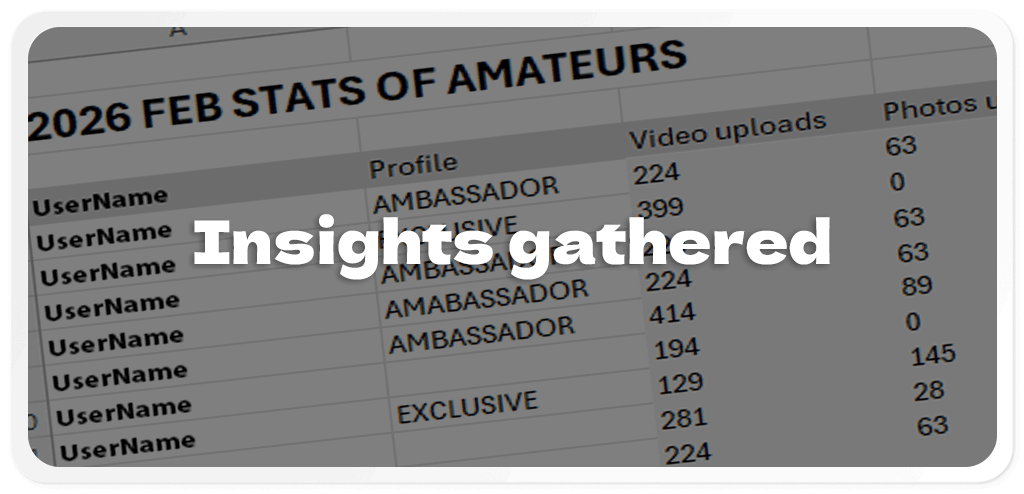
When I received the participant list, things got more interesting. Rather than running identical interviews, I took a more tailored approach. I reviewed each participant’s activity (uploads, webcams, engagement) Looked into their earnings and usage patterns. Researched them externally where possible. At one point, I realized I didn’t fully understand internal user types (e.g., Ambassador vs Exclusive). So I paused and clarified that because without that context, I’d be asking the wrong questions. Then I built: A master template (for consistency). Customized variations per participant Yes, more effort. But with only 10 interviews, depth mattered more than scale. Everything was compiled into a structured spreadsheet: Participant profile Key behaviors and all their activities which would referenced when needed. This helped tailor the questions to each candidate.

The interview sessions themselves went really well. Because, the structure was clear but flexible. Questions were relevant to each user. Participants felt comfortable opening up And something interesting happened:

Users genuinely enjoyed the interviews They felt: Heard Valued Part of the product evolution (Not always a given in user research.)
Outcomes & Impact The result?
A large volume of qualitative insights Clear pain points in workflows Strong signals around pricing perception Multiple actionable product improvements It also required quite a bit of post-interview synthesis (the less glamorous part, but where the real value comes together).

Key Takeaways
Don’t start with questions, start with clarity.
Semi-structured interviews strike the best balance in most cases.
Fewer, deeper questions > long lists.
Tailoring interviews (when possible) unlocks better insights.
Motivated users = better conversations (and no incentives needed)
Good interviews don’t just collect data, they build trust If I had to sum it up: It started as “help structure some questions” and turned into designing a research approach that actually mattered.