

Turning Vague Requests into Measurable UX Impact
A structured approach to aligning design, data, and decision-making
The Problem
As a UX team, we were heavily reliant on Jira tickets to drive our work. The issue was consistent:
most tickets lacked depth.
There was little to no:
- Business context
- Data backing the request
- Clear definition of success
This created two major risks:
- Wasted time and resources building solutions without validated direction
- Weak product outcomes due to unclear intent and lack of measurable impact
At a fundamental level, we were often designing outputs, not outcomes.
My Initial Thinking
I had already started exploring ways to connect design decisions to performance by:
- Linking designs to data dashboards (via Harmony)
- Setting revisit checkpoints to evaluate impact over time
This helped me personally track performance, but it highlighted a bigger issue:
Alignment was fragmented — everyone was looking at different signals, or none at all.
What we needed was shared clarity upfront, not just analysis after the fact.
The Ask
My manager asked me to explore a framework that could:
- Align teams
- Improve clarity in task creation
- Introduce measurable thinking into our workflow
The brief was intentionally open — which gave me space to define the direction.
Exploration & Evaluation
I reviewed several established frameworks:
- AARRR (Pirate Metrics) → Strong for growth funnels, less UX-focused
- North Star Metric → Great for company-wide alignment, too high-level for tickets
- OKRs → Useful for strategy, not granular enough for design tasks
- KPIs → Often too broad for product decisions
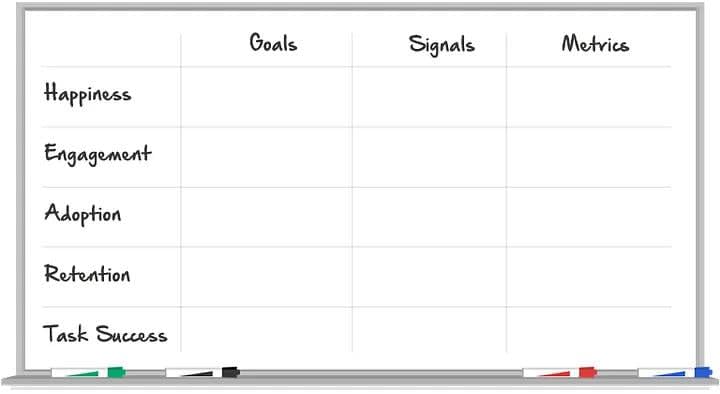
- HEART Framework → Designed specifically for UX, balancing user and product metrics
Conclusion:
HEART offered the best balance between user-centric thinking and measurable outcomes.
Iteration → From Framework to Workflow
Rather than introducing HEART as a theory, I focused on embedding it directly into our existing workflow.
The key idea:
Don’t add process. Improve the quality of what already exists (Jira tickets).
I combined:
- HEART (what we improve)
- GSM – Goals, Signals, Metrics (how we measure it)
Proposed Framework (Embedded in Jira)
Each ticket follows a simple, structured format:
🎯 Goal (HEART Category)
What are we trying to improve?
- Adoption / Retention / Engagement / Happiness / Task Success
💡 Hypothesis
If we do X, then Y will improve because Z
📊 Success Metrics
1–2 key metrics only (focus over noise)
📡 Signal
What user behavior should change?
🧪 Experiment / Change
What are we building or testing?
✅ Success Criteria
Clear, measurable target (e.g. +5%)
🔁 Revisit (Pre-defined Date)
- Did the metric move?
- By how much?
- What did we learn?
Key Principle
Each ticket is no longer just a task —
it becomes a testable hypothesis with a measurable outcome.
Example in Practice
Feature: Revshare dashboard for amateur users
- Goal: Engagement (primary), Retention (secondary)
- Hypothesis: Clear earnings visibility increases motivation and activity
- Metrics: Avg. earnings per user, weekly active users
- Signal: Increased dashboard interaction and earnings activity
- Success Criteria: +5% uplift in both metrics
This creates a direct line from:
Design → Behavior → Business impact
Final Solution
I introduced a lightweight, scalable framework that:
- Embeds directly into Jira tickets
- Standardizes how problems are defined
- Connects UX decisions to measurable outcomes
- Encourages continuous learning through revisit cycles
Impact & Adoption
After presenting the framework to the team:
- It was adopted as the primary working model within the UX department
- Improved cross-team transparency and alignment
- Shifted conversations from “what are we building?” to “why are we building it?”
- Enabled data-informed iteration, not just delivery
Why It Works
- Clarity over ambiguity → Every task has a defined purpose
- Focus over noise → Only 1–2 meaningful metrics per ticket
- Alignment by design → Everyone works from the same structure
- Learning built-in → Every ticket feeds future decisions
Final Takeaway
I transformed Jira tickets from task containers into decision-making tools.
By introducing structure without adding complexity, I helped the team:
- Think more critically
- Design more intentionally
- Measure what actually matters
And most importantly —
build products with real, provable impact.